
Dallara Academy: training in automotive engineering in Italy
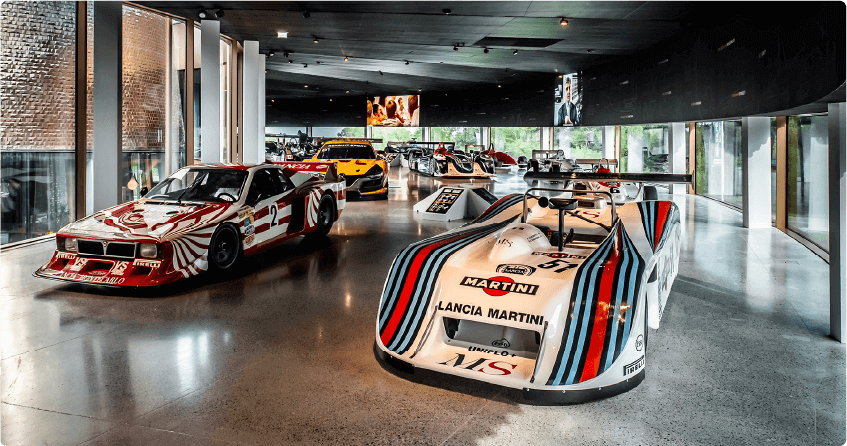
The Dallara Academy, inaugurated in 2018 in Varano de' Melegari, in the Parma region, is today one of Europe's leading automotive engineering centers, located in the heart of the Italian Motor Valley, the same region that houses Ferrari, Lamborghini, Ducati and Maserati. Founded by the company Dallara Automobili, which since 1972 has been designing and manufacturing chassis for categories such as Formula 2, Formula 3, IndyCar and Le Mans, the Academy combines museums, educational laboratories, professional simulators and a university master's program in a single space. For families with children interested in engineering, design or the world of racing, understanding what this structure offers and how it connects to international training trajectories is the starting point of this reading.
What is the Dallara Academy and where is it located?
The Dallara Academy is the educational and cultural center of Dallara Automobili, an Italian company founded by engineer Gian Paolo Dallara in 1972, which designs and manufactures racing chassis for the main categories of world motoring. The center is located on Via Provinciale, 33/A, in Varano de' Melegari, in the interior of Emilia-Romagna, about 40 minutes from Parma.
The building, designed by the architect Alfonso Femia, integrates the landscape of the Ceno Valley with a contemporary architecture that organizes the space on four distinct fronts:
- Exhibition Ramp: exhibition ramp with vehicles representing over 50 years of Dallara history, including Formula 2 cars, Indycars, Le Mans prototypes, Formula E cars, and the Dallara Stradale street model.
- Factory tour: guided tour of the production areas where the chassis used in real competitions are manufactured.
- Yes Racing Xperience: state-of-the-art professional simulators where visitors and students can drive virtually on international circuits.
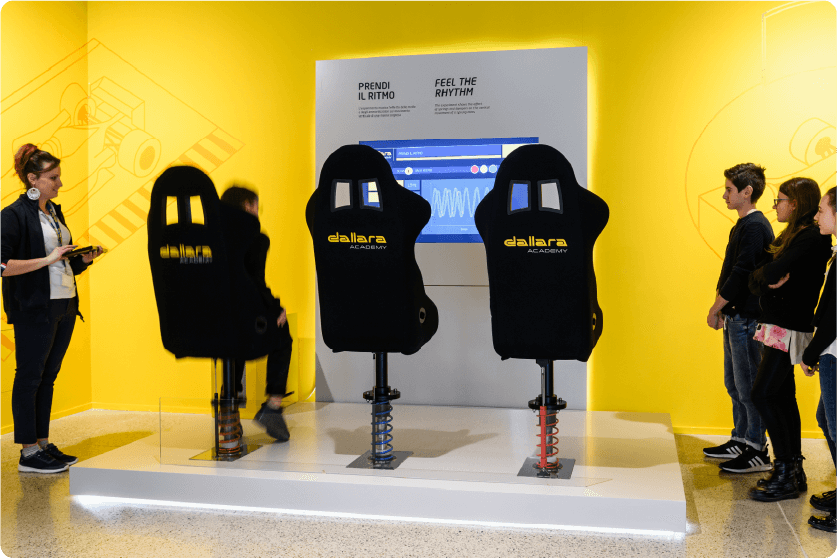
- Educational Labs: three laboratory rooms dedicated to practical physics experiments applied to automotive engineering.
According to data from the Italian Motor Valley, the Academy receives more than 30,000 visitors a year, including schools, universities and motoring enthusiasts. But the most relevant aspect for young students is not the volume of visitors: it is what happens inside the educational laboratories and in the university area on the first floor.
What do young students learn in the Dallara Academy laboratories?
The educational laboratories at Dallara Academy are designed specifically for high school and elementary school students. Philosophy is what the institution itself calls “edutainment”: learning by doing, with real physical experiments instead of theoretical presentations.
The content of the laboratories is organized in three axes, directly inspired by the company's three core activities:
- Composite materials: students touch and test carbon fiber materials, notice differences in stiffness, and understand why these materials replaced metal in modern competition chassis.
- Aerodynamics: experiments with miniature wind tunnels that demonstrate the principles of downforce and drag, the same that engineers calculate for each Formula car.
- Vehicle dynamics: simulations of the forces that act on the car and the driver during curves, braking and acceleration, connecting school physics to the real context of the races.
This format makes engineering concepts palpable for a 15- or 16-year-old adolescent who has not yet studied differential calculus. The connection between class content and what happens in a Formula 2 qualifying lap is immediate. Students who pass through these labs leave with a practical understanding of applied physics that most school curricula don't offer.
The university program at Dallara Academy
The first floor of the building houses the university space that houses the second year of the master's degree in Racing Car Design, offered by MUNER, the Motorvehicle University of Emilia-Romagna, created in partnership with the universities of Bologna, Modena and Reggio Emilia, Ferrara and Parma.
The MUNER master's degree in Racing Car Design is a two-year program aimed at engineers who want specialization in the design and manufacture of racing cars. The course focuses on fundamental and applied aerodynamics, advanced vehicle dynamics, lightweight design, and carbon fiber chassis manufacturing. The second year of the program is carried out entirely at the Dallara Academy, with access to the company's actual facilities.
Program partners include Ferrari, Lamborghini, Ducati, the Haas F1 team, and Dallara herself. This means that students develop laboratories and thesis projects in direct contact with the companies that build the cars that compete in the highest categories of motor racing worldwide.
For families thinking about graduating and graduating, this is a concrete fact: there is a university structure in Italy specialized in automotive racing engineering, installed within one of the largest chassis manufacturers in the world, with partners at the level of Ferrari and Haas F1. The trajectory that begins in a summer program can be extended, years later, to a specialization at that level.
Why does Varano de' Melegari occupy a unique place in motorsport?
Varano de' Melegari is a small town with about 2,000 inhabitants in the province of Parma. But her weight in world motorsport is disproportionate to her size. Dallara Automobili was founded there in 1972 and since then it has manufactured the chassis that cover the Formula 2, Formula 3, American IndyCar and World Endurance Championship circuits in the same region.
In addition to the factory, the city has the Autodromo Riccardo Paletti, a permanent circuit used for vehicle development tests, located a few minutes from the Academy. For an engineering student, the combination of factory, circuit and training center in the same territory is a rarity that no classroom reproduces.
That concentration is part of what defines Motor Valley. The region between Modena, Parma and Bologna is home to a density of companies and institutions linked to motoring that does not exist anywhere else in Europe. O Be Easy motorsport exchange program was built thinking exactly about this geography: technical visits to facilities in this region form a layer of practical learning that complements classroom training.
The Dallara Academy in the context of automotive training in Italy
Italy has a specific position in the training chain for automotive engineering and design professionals. Turin is home to the Fiat Centro Stile and the automobile museum. Milan is home to the largest industrial design studios in Europe. And the Motor Valley, in Emilia-Romagna, is where chassis are designed, manufactured, and tested.
For a young person considering pursuing this sector, each of these cities has a different role in the journey:
- Milan: training in transportation design, sketching, digital rendering, clay modeling. The creative study environment, with connections to the Politecnico di Milano and the Salone del Mobile.
- Turin: oldest industrial history, home to major design centers such as Italdesign, which combines engineering and aesthetics.
- Motor Valley (Modena, Parma, Bologna): competition engineering, aerodynamics, composite material manufacturing, vehicle dynamics.
International programs focused on automotive design that include visits to Motor Valley, such as the one that Be Easy curated for the summer of 2026, connect these three environments in a single itinerary. Students who work in sketching laboratories in Milan and then visit the Dallara Academy leave with an understanding of the sector that goes from the creative concept to the physical prototype. O Automotive design guide for young people deepen these connections for families who want to understand how to set up this training path.
What does a summer program in Northern Italy offer in practice?
A two-week residential program based in Milan for students aged 15 to 18 structures training in three progressive modules:
- Design Foundations & Sketching: body proportions, perspective techniques, car design fundamentals. The student learns to communicate an idea visually before any software.
- Digital Rendering & Basic 3D Exploration: digital rendering tools, introduction to 3D software, transposition of the manual sketch to the digital environment.
- Clay Modelling & Industry Experience: clay modeling on a 1:10 scale, the same method used by professional manufacturers to validate volumes before digital prototyping. The module ends with the presentation of a specific automotive concept: refined sketch, digital rendering and physical model in clay.
The program includes 30 hours of class and laboratory, with technical excursions to Italdesign, the National Automobile Museum in Turin, Pagani Automobili and the ADI Museum in Milan. These destinations aren't generic cultural visits: each one covers a different aspect of the sector, from mass production design to niche hypercar engineering.
The accommodation is in a university residence in the center of Milan, with individual rooms, 24-hour supervision and meals included. The ideal student profile has English at least level B1, since classes are conducted in English, and there is no need to have previous training in design or engineering.
What is the profile of young people who enjoy this journey the most?
The question that families usually ask is: “does my child need to already know how to draw to participate?” The answer is no. The program starts from scratch in technical terms. What differentiates those who make the most of it is not prior drawing skills, but curiosity about the sector and willingness to work with their hands.
The profiles that move the most forward over the two weeks tend to have some characteristics in common:
- Active interest in cars, racing, technology, or industrial design, not necessarily all at the same time.
- Willingness to receive technical feedback and review one's own work.
- Engagement with the studio routine: class mornings, laboratory afternoons, presentation of results to the group at the end of the week.
For students who are already practicing some visual activity (arts, modeling, game architecture, 3D printing), progress tends to be faster. But it's not a requirement. The program was designed for high school students, not for designers in advanced training.
The international context of the program also matters. Studying alongside teenagers from other countries, in English, in a city like Milan, places students in an environment of comparison and encouragement that local programs do not reproduce. Os exchange programs for teenagers that combine technical training and international immersion have this practical effect: they accelerate the maturity of vocational choice in a phase in which the student still has time to adjust the direction.
What to expect from the curriculum after the program?
A summer program in automotive design in Italy does not replace graduation, but produces concrete curriculum elements that make a difference in the university application process. The student leaves with:
- Certificate of completion of the program in English.
- Portfolio with sketches, digital renders and photographic record of the clay model.
- Technical vocabulary in English for interviews and motivation letters.
- International reference verifiable by admission commissions from design and engineering universities.
Applicants to industrial design, mechanical engineering, or transportation design programs at European universities compete with students from around the world. A portfolio with works produced in an international environment, with professional methodology, is a differential that already appears in the initial screening of the application.
Frequently asked questions about the Dallara Academy and automotive training in Italy
What is the Dallara Academy?
The Dallara Academy is the educational and cultural center of Dallara Automobili, an Italian company founded in 1972 in Varano de' Melegari (Parma). The space combines a museum, applied physics laboratories for high school students, professional simulators and the second year of MUNER's university master's degree in Racing Car Design, in partnership with Ferrari, Lamborghini and the Haas F1 team.
Can high school students visit or participate in activities at the Dallara Academy?
Yes. The Academy maintains educational laboratories created specifically for high school and elementary school students, with practical experiments in physics applied to aerodynamics, composite materials, and vehicle dynamics. School groups can schedule tours with guided activities.
What is Motor Valley and why is it important for those who want to pursue automotive engineering?
The Motor Valley is a region in Emilia-Romagna, in northern Italy, that concentrates high-performance motoring companies and institutions: Ferrari, Lamborghini, Maserati, Ducati, Pagani and Dallara are all within a radius of about 100 km. For automotive engineering and design students, the region represents the largest hub of practical knowledge in the sector in the whole of Europe.
Does an automotive design program in Milan have a connection with the engineering that takes place in the Motor Valley?
Yes. Programs that include technical visits to Italdesign, the National Automobile Museum in Turin and the Motor Valley connect the studio work done in Milan with the industrial reality of production. The student understands, in practice, how a creative concept leads to a chassis made of carbon fiber.
At what age does it make sense to start building this trajectory in automotive design or engineering?
Summer programs are designed for students aged 15 to 18 and do not require prior training in design or engineering. Starting during high school allows students to validate their vocation before choosing graduation, build a verifiable portfolio, and gain international experience before the university application process.
Be Easy: Boutique exchange consultancy
Be Easy accompanies families who want to give their child a real advantage before college. If your child is interested in automotive engineering, transportation design, or the world of motoring, we have the curating right for him to build this trajectory in the right environment, be it a summer program in Milan, a technical visit to the Motor Valley or an application consultancy for university programs in Europe. To understand the options available and speak with a dedicated senior consultant, contact us.

