
Oxford vs Cambridge: which city to choose for the engineering summer camp?
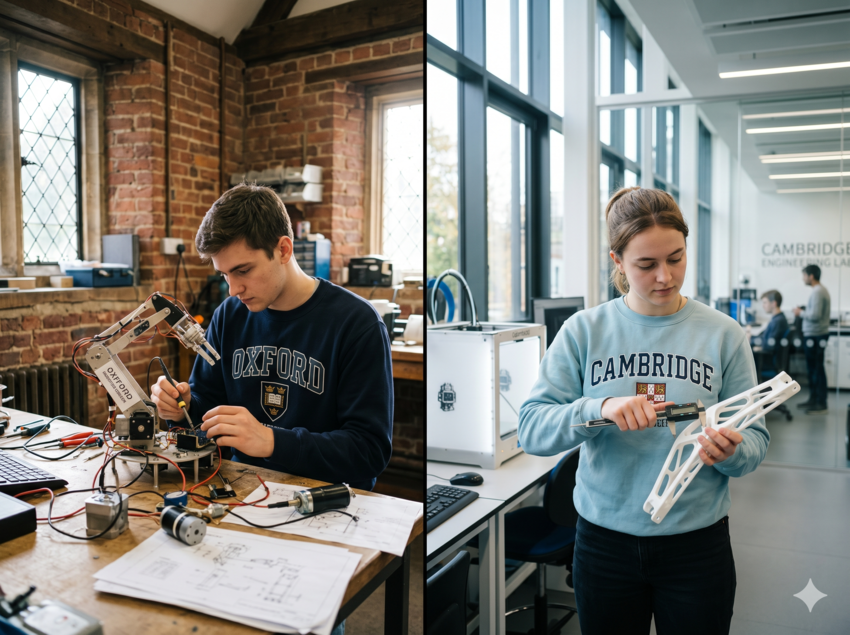
Choosing between Oxford and Cambridge for an engineering summer camp is one of the questions that come to our consultants the most, and the answer depends less on the fame of the cities than on what your child has to build. Both options offer serious programs, qualified tutors, and an academic environment that few destinations in the world can replicate. But the format of the content, the weight of the credentials, and the pace of the experience vary in concrete ways. This article shows exactly what sets each city apart and how to make that decision clearly.
Why are Oxford and Cambridge the go-to destinations for engineering summer camps?
Oxford and Cambridge consistently lead the global engineering rankings, according to the QS World University Rankings 2025. More than prestige, what places them in this position is their academic density: tutors with active doctorates, pedagogical methodologies different from conventional classrooms, and an environment in which intellectual rigor is part of everyday life.
For a 16- to 18-year-old student who is building their application for elite universities, participating in a program in these cities communicates two things to the evaluator: ability to operate in high-level environments and real initiative to explore the area. Neither city loses to the other at this point. The distinction begins when we look at what each program delivers in practice.
What is the difference between programs at Oxford and Cambridge?
The most relevant difference lies in the pedagogical format and the accreditation profile available in each city.
- Oxford focuses on two types of programs with very different characteristics. The first replicates the tutorial methodology characteristic of the university itself: the student works in groups of two with a DPhil or MRes level tutor, discusses the concepts, defends their reasoning and receives direct feedback. There is no expository class in the conventional model. The pace is more demanding for those who expect a passive dynamic, but it is precisely this format that generates the application differential. The second format is aimed at exploring careers in engineering: visits to companies, career coaching, and reflection on areas of activity. Both formats may include an upgrade of 8 UCAS points and a letter of recommendation upon performance evaluation.
- UCAS points are credits recognized by the British university system for admission to UK colleges. An add-on of 8 UCAS points, available in the Oxford and Cambridge programs, reinforces the candidate's dossier.
- Cambridge offers a similar structure in terms of ATHE accreditation and optional UCAS upgrades and letter of recommendation. In addition, there is a larger STEM program, held at schools in the city, aimed at students from 14 to 17 years old who are still exploring what area of science and technology they want to pursue. This format includes three progressive modules: fundamentals of mathematics and physics, computer science and programming, and engineering principles. Cambridge offers four dates available in July and August 2026, against two in Oxford, which provides more flexibility for those who are adjusting their child's calendar.
In short: Oxford has the closest tutorial format to the real university model and works best for those who already know that they want engineering and want to develop critical thinking in this area. Cambridge has more dates, includes a STEM option for younger profiles, and maintains an equivalent accreditation structure in programs from 16 to 18 years old.
What does each city's environment add to the experience?
In addition to the program itself, the city matters to the student's daily life during the two weeks of immersion.
Oxford is a smaller, more compact city built around the university in a way that few places in the world replicate. Walking around the colleges, using the same library as doctoral students, and dining in historic dining halls is part of the routine. For an adolescent considering applying to Oxford, this immersion has a concrete value: he begins to understand the rhythm of the city, the density of the spaces, and what it means to study there.
Cambridge shares similar characteristics, with the Rio Cam and bicycles as part of the everyday scene. The city has a slightly more relaxed pace than Oxford. To understand how each program is positioned within this context, Complete guide to engineering summer camps in England details the programs available in each city, including accommodation format and content structure.
Neither city is better than the other in terms of environment. What determines the choice is whether the city has the program format that best serves your child's purpose at that time.
What Oxford student profile makes the most sense for?
Oxford works best for students who have decided they want engineering and want to deepen their analytical thinking in the area.
Profiles that fit well:
- Students from 16 to 18 years old with a maturity for debate dynamics and the defense of reasoning.
- Students with a direct interest in applying to top British universities.
- Those seeking the ATHE credential combined with the most reflective and demanding learning style.
- Students willing to develop an engineering project with individual written evaluation.
The Oxford tutorial program requires the student to arrive willing to speak, question, and be questioned. For those who prefer to passively absorb content, the format can be frustrating. For those who want to be challenged, this productive friction is the main differential of the program's return.
What Cambridge student profile makes the most sense for?
Cambridge is most suitable when students are 14 or 15 years old and are still exploring which area of STEM they want to pursue. The Cambridge STEM program, held at a partner school in the city, was designed exactly for that moment.
Cambridge is also worth considering when:
- The family calendar has restrictions that require more flexible dates.
- The main objective is academic immersion at university level with accreditation equivalent to that of Oxford.
- The student is 16 to 18 years old but prefers a curriculum in progressive modules rather than the strictly tutorial format.
For students aged 16 to 18, the choice between Oxford and Cambridge in academic engineering programs becomes less determinant by the content and more by the availability of dates and the personal profile. O STEM program in Cambridge for 14-17 year olds it has its own structure that responds to a different moment of development: before specialization, when the student is still calibrating whether engineering is really the path.
Is it worth combining the two programs?
Yes, in specific contexts. The most strategic combination frequently accompanied by our team is an academic program in Oxford or Cambridge followed by an industrial work experience in London. The academic program provides the university credential, the UCAS points, and the letter of recommendation. The program in London provides direct contact with engineers from internationally recognized companies, 50 to 65 hours of documented work experience and a second reference letter with an industrial profile.
This combination covers the two pillars that British and American universities value most in international candidates: academic depth and practical initiative. To understand how to set up this project in a manner consistent with your child's profile, our curating analyze each variable before indicating the most appropriate format.
In short: Oxford or Cambridge as an academic base, London as an industrial complement. The three cities together form the most comprehensive project available under Be Easy's curatorship for engineering in the United Kingdom.
Frequently Asked Questions about Oxford vs Cambridge Summer Camp Engineering
Is the accommodation in the universities' historic colleges?
In Oxford and Cambridge residential programs, students stay at the universities' own historic colleges, with meals and support included. This immersion is part of the experience and directly contributes to the university application context.
Is the letter of recommendation guaranteed in both programs?
No. The letter is an optional upgrade available at Oxford and Cambridge, issued by the tutor at the end of the program. It is subject to student performance, attendance, and engagement during the two weeks. It is not possible to guarantee the letter at the time of enrollment.
What are the accepted ages in Oxford and Cambridge programs? University-level academic programs at Oxford and Cambridge accept students aged 16 to 18. Cambridge also offers a specific STEM program for 14-17 year olds, with broader content and a different academic format.
Are Oxford UCAS points worth the same as Cambridge's?
Yes. The 8 UCAS points available as an upgrade in Oxford and Cambridge programs carry the same weight within the British university application system, as both are accredited by ATHE, a recognized qualification body in the United Kingdom.
Is it possible to know in advance which tutor will be allocated to the program?
Tutors are allocated closer to the program start date, not at the time of enrollment. The tutors' profile is documented, but a specific name cannot be guaranteed beforehand.
Be Easy: boutique exchange consultancy
Be Easy accompanies families who want to give their child a real advantage before college. If your child's profile points to engineering in the UK, we have the curating right to identify whether Oxford or Cambridge, and which specific format, best responds to what it needs to build now. To discuss the options available in 2026 and speak with a dedicated senior consultant, contact us.

