
Visa to study and work in Germany in 2026: updated requirements
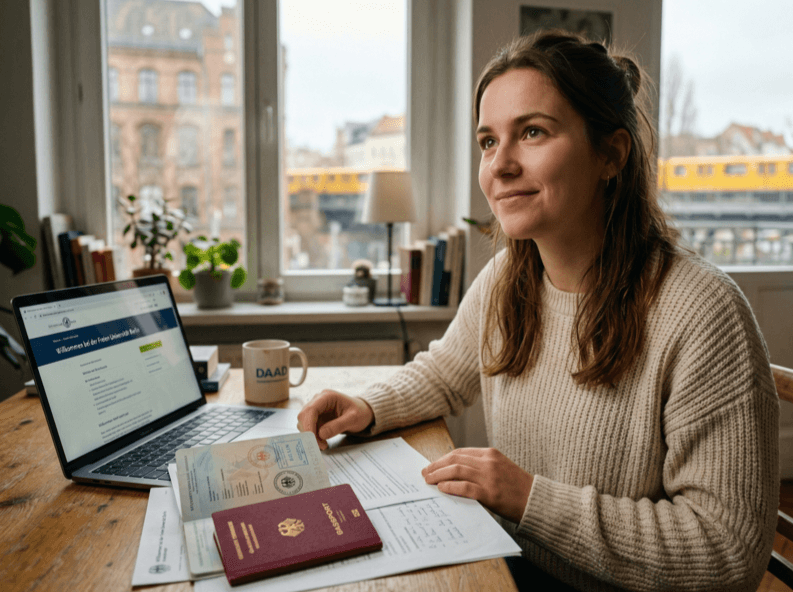
Germany is a destination for those who want to combine academic training with entry into the European labor market, and the 2026 visa system has options for different profiles: the student visa (Studentenvisum) for those who have already been admitted to university, the Chancenkarte for qualified professionals who want to seek employment without prior offer, and the EU Blue Card for those who already have a contract in hand with a salary above €43,800 per year. The program Study and Work in Germany from Be Easy details how each modality works in practice and which one best fits each career moment.
What are the main types of visas to study and work in Germany?
Germany offers different types of entry and residence permits, each aimed at a specific profile. For those who want to study and work, the main ones are:
- Student visa (Studentenvisum): for those who were admitted to a university or Studienkolleg Germans
- Chancenkarte (Opportunity Card): for qualified professionals who want to seek employment without having a prior offer
- Seen from job search (Jobsuchervisum): for professionals with recognized qualifications who want to reside temporarily while seeking placement
- Residence permit for skilled work: For those who already have a job offer in hand
Each modality has different requirements, deadlines, and work rights. Understanding which one fits your moment is the first step.
What is a student visa for Germany and what are the requirements?
The German student visa (Studentenvisum) is issued to someone who has been accepted to a German university recognized by the government. It authorizes residence in the country for the duration of the course and allows paid work with a limit of 20 hours per week (or 140 days of full-time work per year).
The documents required for the application at the German consulate include:
- VIDEX form completed online, printed and signed
- Valid passport with at least two years of validity
- Letter of admission or confirmation of enrollment at a German university
- Proof of sufficient financial resources (see below)
- Photo in biometric pattern
- Health insurance valid for the period of stay
- Proof of language knowledge, when required by the course
The student visa issuance fee is €75.00.
How much money do you need to prove? For 2026, the German government requires students to prove availability of at least €992.00 per month, which is equivalent to €11,904.00 for 12 months. This value can be demonstrated by:
- Blocked account (Sperrkonto) in an approved bank
- Letter of guarantee from a family member resident in Germany
- Scholarship or institutional funding letter
The blocked account (Sperrkonto) is the option most used by international students without family ties in Germany. The amount is deposited and can be withdrawn monthly up to the allowed limit.
What changed for students in 2026: the new 140-hour rule
One of the most relevant changes for those studying in Germany is the extension of the working hours limit for international students not belonging to the European Union.
Previously, the rule allowed working 120 full days or 240 half days a year. As of March 2026, with the entry into force of the amendment to paragraph 16b of the German Residence Act (Aufenthaltsgesetz), the limit changed to:
- 140 full days a year (or 280 half periods)
This represents an increase of approximately 17% in the workload allowed, which translates into a potentially higher annual income for the student.
It should be noted that the compulsory internship hours provided for in the course curriculum do not count against this limit. The same goes for work as an academic assistant (HiWi) within the university itself.
With the German minimum wage from €13.90 per hour (effective as of January 1, 2026) and the limit of 20 hours per week, students can earn:
- 20h x €13.90 = €278.00 per week
- Monthly estimate: approximately €1,204.00
During vacation periods, when working hours can be extended, income can be considerably higher.
What is Chancenkarte and how does it work for those who want to work in Germany?
A Chancenkarte (Opportunity Card) allows qualified professionals from non-EU countries to move to Germany for Up to 1 year to seek employment, even without having a job offer in hand.
There are two ways to request it:
Path 1: Equivalent recognition. If your foreign qualification is fully equivalent to a recognized German qualification, you only need to prove sufficient financial resources for the stay.
Path 2: Point system. If the qualification is not fully equivalent, it is necessary to accumulate at least 6 points based on criteria such as:
- Partial recognition of the qualification in Germany
- Knowledge of German (above level A1)
- Knowledge of English (level B2 or higher)
- Qualified professional experience
- Relationship with Germany (previous stay, partner or family in the country)
- Age (progressive score for those under 35)
The Chancenkarte holder must prove the availability of at least €1,091.00 per month (€13,092.00 for 12 months). During the term of validity, you can legally reside in Germany, work up to 20 hours a week in any sector, participate in selection processes and, if you obtain a qualified offer, convert Chancenkarte to a residence permit without having to return to the country of origin.
How does the residence permit (Aufenthaltserlaubnis) for students work?
A student visa allows you to enter Germany, but it is not the same document that authorizes an extended stay. Upon arrival, the student must request the Aufenthaltserlaubnis (residence permit) no Ausländeramt (Department of Foreigners) competent for your municipality of residence.
The deadline for making this request is up to 90 days after entering the country.
A residence permit for study purposes is normally issued with a validity of biennium, renewable for another two years if the course has not yet been completed.
Brazilian citizens have an advantage in this process: they can enter Germany without prior visa and apply for a residence permit directly in the country, provided that they are regularly enrolled at a German university.
After completing the course, the student can apply for a job search visa for up to 18 months to remain in Germany while seeking a placement in your area of training. If a qualifying job offer is closed during this period, the permit can be converted to a permanent work permit without the need to leave the country.
What are the work visas for those who already have a job offer?
For those who have already secured a position in a German company, the main paths are:
- Skilled work visa (Fachkräftevisum): for professionals with recognized qualifications in regulated professions or with a university degree. It requires prior recognition of the qualification or positive preliminary statement of the competent authority.
- EU Blue Card: aimed at highly qualified professionals with a salary above the limit defined annually (in 2026, approximately €45,300/year for most professions or €35,300/year for areas with a shortage of labor). It offers a faster path to permanent residence.
- Residence permit for qualified immigration: covers a wider range of professions based on the reforms of the immigration law for qualified professionals (Fachkräfteeinwanderungsgesetz), in force since 2024.
How long does it take to process a German visa?
The processing time varies depending on the consulate, the type of visa, and the volume of requests. As a general reference:
- Student visa: between 4 and 12 weeks
- Chancenkarte: between 4 and 12 weeks
- Skilled work visa: it can be faster with the accelerated procedure (Beschleunigtes Fachkräfteverfahren), up to 4 weeks for registered companies
The expedited procedure is an option for companies that hire qualified workers from abroad and want to streamline the admission process. The company assumes part of the responsibility for the bureaucratic process.
Language requirement: German or English?
Language requirements vary depending on the type of visa and the candidate's profile:
- Student visa: depends on the language of the course. Courses in German require level B2 or C1. Courses in English accept certificates such as IELTS, TOEFL, or Cambridge.
- Chancenkarte: requires German at minimum level A1 or English at level B2.
- Blue Card and qualified work visa: the language requirement is mainly defined by the contracting company and the sector in which it operates. Regulated professions such as medicine, nursing, and law require an advanced level of German.
Having a B1 or B2 level of German considerably increases job opportunities and integration in the country, even if the language is not mandatory for the specific visa.
FAQ: frequently asked questions about the visa to Germany in 2026
Do Brazilians need a visa to enter Germany?
For stays of up to 90 days for tourism or business purposes, Brazilian citizens can enter without a visa. To study, work or stay for more than 90 days, a specific visa is required for the intended purpose or the application for a residence permit upon arrival.
How much does it cost to apply for a student visa to Germany?
The national visa (type D) issuance fee is €75.00. Chancenkarte also costs €75.00. The rates may be updated annually.
Does Chancenkarte allow you to work for 12 months?
Yes, up to 20 hours a week in any sector. The main purpose is the search for qualified employment, but part-time work is allowed to supplement income during this period.
Is it possible to bring family when applying for Chancenkarte?
Yes, provided that the proven financial resources also cover the support of the dependents. A spouse or partner who goes together may be entitled to work and must have at least A1 level of German.
What is the difference between a Blue Card and a residence permit for skilled work?
The Blue Card has stricter minimum wage requirements but offers a faster path to permanent residence (21 months with B1 level of German, instead of the standard 4 years). A skilled work permit is more affordable, but the path to permanent residence is longer.
Be Easy: Boutique exchange consultancy
Understanding which visa applies to your profile is the starting point for planning a solid experience in Germany. At Be Easy, our curating includes mapping the right options for each career moment and the support of a dedicated senior consultant who knows this path up close. Contact us to take the first step clearly.

