
Eton College: how to study at the boarding school in England
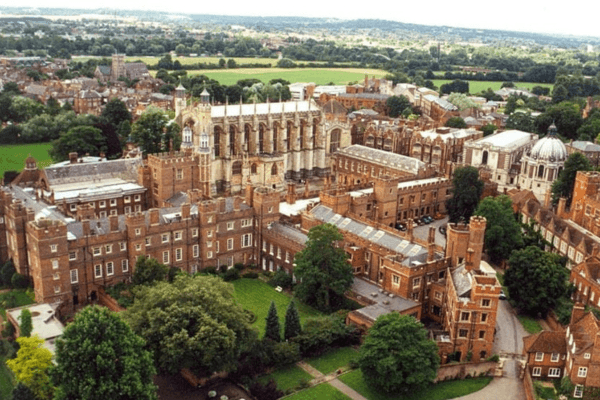
There are two ways to study at Eton College: a two-week summer immersion on campus, co-ed (boys and girls, ages 14 to 18), or full-time boarding, for boys from age 13, with highly selective admission.
This guide separates requirements, timelines and profile for each format, so the family chooses the right project before locking onto the name alone.
Two distinct paths on the Eton campus
- Summer immersion: about two residential weeks on campus, co-ed format, designed for qualified international students.
- Full-time boarding: highly competitive admission, multi-year planning, and requirements of the British system.
Understanding the difference from the start avoids wrong expectations and focuses planning on the right format for your family.
How do you study at Eton College?
Studying at Eton College means choosing between two formats with different requirements, timelines, and goals:
- More accessible: summer immersion on campus.
- More selective: full-time boarding.
Understanding the difference early avoids wrong expectations and keeps planning focused on the right track.
The summer immersion programme at Eton
Eton’s residential summer programme welcomes students aged 14 to 18 from more than 80 nationalities through an accredited partner operator.
In practice, the format includes:
- Duration of two weeks.
- Co-ed format (boys and girls).
- The student lives, sleeps, eats, and studies on the Eton campus in Berkshire.
Methodology: practical projects, digital campaigns, UN-style debates, innovative solutions, and presentations to multicultural audiences.
The curriculum builds 21st-century skills: digital innovation, critical thinking, global communication, and leadership. At the end, the student receives an official programme certificate.
Eton campus facilities:
- Individual rooms with 24-hour supervision.
- Professional indoor pool, gyms, climbing wall.
- Fencing hall, tennis and squash courts.
It is not a simulation of Eton: it is the Eton environment.
That is why short-stay boarding in England has gained ground among families who want to test the British model before committing to full-time boarding.
Full-time boarding: what the admissions process requires
Full-time boarding at Eton is boys-only and serves students from age 13.
Competition is extremely high: places are limited, admissions require tests, interviews, and academic references, and places for international students are even more contested.
For families who want this path, Be Easy’s high school curation abroad starts with a realistic map.
- Eligibility of the student’s profile.
- Application calendar and deadlines.
- Required documentation.
- When relevant, schools at a similar level with a more accessible process for international students.
Guidance from a dedicated senior consultant is what separates an organised application from a process lost in spreadsheets and disconnected deadlines.
What is the difference between summer immersion and full boarding?
Summer immersion and full boarding serve different goals and do not compete with each other.
A student can use the two immersion weeks to explore an elite British setting, leave with an international network and a certificate, and use that experience to strengthen future applications to long-term boarding schools.
Three practical distinctions:
- Duration and format: summer immersion lasts two weeks, is co-ed, and accepts international students aged 14 to 18. Full boarding is year-round, boys-only, and requires a multi-year competitive admissions process.
- Selectivity: immersion needs a motivated profile suited to an intensive format; full boarding needs a rigorous academic record, references, and a multi-stage process.
- Main goal: immersion prioritises leadership, soft skills, and an international network. Full boarding offers a complete British curriculum (including GCSEs and A-Levels), strong university credentials, and long-term cultural immersion.
The Cambridge A-Levels preparatory programme is a relevant third path for international students who want a British credential without full boarding.
Why does Eton attract so much international interest?
Eton College was founded in 1440 and is located in Berkshire, a few kilometres from Windsor. Over more than five centuries it has educated 20 British prime ministers and remains part of the academic excellence landscape for families seeking a world-class boarding school.
Renewed attention around Eton reflects two movements at once. The first is global growth in demand for elite British boarding as a passport to universities such as Oxford, Cambridge, Imperial, and LSE. The second is the news cycle around Prince George and the path into British schools, which has brought the topic back into the mainstream even for families who had not yet considered British boarding.
There is an ecosystem of top-tier British boarding schools, with different profiles, specialisms, and admissions processes. Elite British boarding for international students varies by fit: the right school depends on the student, not only on the prestige of the name.
Student profile for the Eton summer programme

The immersion programme selects young people who show intellectual initiative and a willingness to collaborate with peers from very different cultures.
There is no single profile, but there are recurring attributes among students who get the most from it:
- Genuine curiosity for debate and complex problem-solving
- Comfort with English in academic settings (native fluency is not required, but students must follow day-long dynamics in English)
- Interest in leadership, entrepreneurship, or international careers
- Ability to adapt to residential routines with supervision and structured schedules
- Openness to building relationships with peers from more than 80 countries in a few weeks
This profile aligns with what admissions teams at British, American, and European universities value: evidence of collective impact, not only individual grades.
It is the same kind of evidence that high school abroad, as preparation for university applications, helps build over time.
How does planning work in practice? How far ahead should you start?
For the summer immersion programme, ideal planning starts four to six months before the start date.
That leaves enough time for documentation, cultural orientation, and choosing the right week within the available calendar.
For full boarding, the horizon changes completely. Schools at Eton’s level often register interest two or more years ahead. Starting early is not an advantage: it is a prerequisite.
Be Easy curation includes:
- Profile analysis and alignment with the most suitable programme type
- Mapping of dates, requirements, and documentation
- Cultural and academic orientation before departure
- Full logistics support (student visa, accommodation, family communication during the programme)
- Post-return follow-up for students who pursue full boarding
Boarding at Mill Hill in London and Aldenham School in England are examples of high-reputation British schools whose admissions curation is also managed by Be Easy.
Frequently asked questions about boarding schools in England and Eton College
Is the Eton summer programme open to girls?
Yes. The residential summer programme on the Eton campus is co-ed and accepts boys and girls aged 14 to 18. Regular full boarding at Eton during the school year is boys-only.
What language is used in the summer immersion programme?
The programme runs entirely in English. The student needs enough proficiency to follow debates, presentations, and collaborative activities throughout the day. Native English is not required, but the level must be functional in an academic setting.
Does summer immersion at Eton increase the chance of full boarding admission?
Immersion is an independent experience and does not guarantee a place in full boarding. Still, it offers real contact with the British environment and standard, which can guide the decision better and strengthen the profile for selection processes at schools of a similar level.
What is the difference between a boarding school and a British high school?
A boarding school is residential: the student lives at school during term. High school describes the level of study (upper secondary) and may be residential or day school.
How does Be Easy support families seeking long-term British boarding?
Be Easy maps the student’s profile, identifies the most suitable schools in the elite British ecosystem, guides timeline and documentation, and supports the process with a dedicated senior consultant at every stage.
Is Eton the destination or the starting point of the boarding project?
Full boarding at Eton is an elite, highly selective route. Summer immersion on campus is another path, with different timelines and profiles. Before locking onto a single name, align your child’s profile, format, and calendar with a senior consultant and the High School abroad programme. That way the boarding project in England is built with method, not only desire.
Be Easy: boutique exchange consultancy
Be Easy supports families who want a real edge for their children before university. Whether the interest is two weeks on the Eton campus or a full pathway in a British boarding school, we provide the right curation and a dedicated senior consultant at every stage. Contact us for specialised senior guidance!

