
English-language boarding school in Europe: which countries offer an international curriculum without requiring the local language?
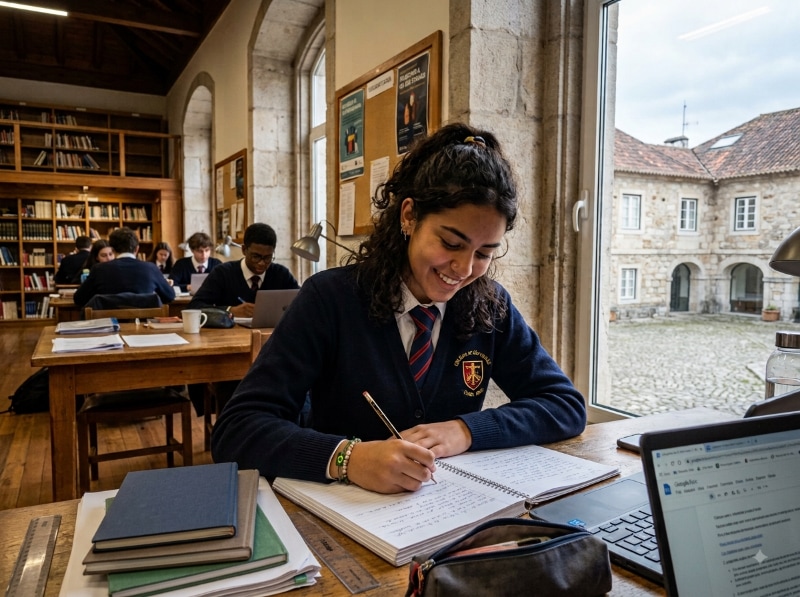
Four European countries concentrate a large share of English-language boarding schools with an international curriculum: Spain, Italy, Switzerland, and Portugal. There, students take IB, British, or American curriculum without needing Spanish, Italian, French, or Portuguese as the language of instruction.
The choice among them is not only geographic. Climate, academic pace, campus profile, and the path to university change the family fit. Below is the map of what high school abroad curation usually presents when the priority is 100% English and a diploma recognised outside the local system.
What does an English boarding school with an international curriculum mean?
An English boarding school with an international curriculum is a residential school where classes, assessments, and academic life run in English, with a diploma accepted by universities in many countries.
The International Baccalaureate (IB) is the two-year diploma programme created by the IBO, with global recognition.
- IB Diploma: balanced rigor, Theory of Knowledge, Extended Essay, and CAS
- British curriculum: IGCSE and A-Levels with earlier specialisation
- American or hybrid curriculum: credits, AP, and preparation for US applications
British and American curricula also fall into this portable-diploma category. The local language does not need to be an entry prerequisite.
Spanish in Madrid, Italian in Milan, or French in Geneva become cultural and optional learning, not an admission barrier. The IB curriculum preferred by elite universities appears often in European boarding schools precisely because of that portability.
Why is the local language no longer a requirement in these countries?
Because these schools operate as international campuses inside the host country. Faculty teach in English, academic documentation is issued in English, and the student body mixes dozens of nationalities.
That reduces the adaptation curve in the first semester. The teenager focuses on settling into boarding life and keeping up with class pace.
- Priority on academic English and a portable diploma: the 100% English model usually fits better
- Priority on immersion in the local language: bilingual high school or a high load in the country’s language makes more sense
Bilingual boarding schools in Spain, Italy, and Portugal sit on the second path: strong English, with more room for the country’s language.
Spain: academic English with Mediterranean life
Spain combines a milder climate, cultural proximity, and international schools with English as the language of instruction. Cádiz, Madrid, and Toledo concentrate a large share of English boarding options.
In the south, the boarding school in Sotogrande, on the Cádiz coast is a reference international campus with an English curriculum.
- Classroom English without relying on advanced Spanish on day 1
- Mediterranean social life, with a cost of living generally more accessible than Switzerland or London
- Network of international schools in large cities and coastal areas, including British curriculum in Madrid and boarding in Toledo
Spanish enters as a natural bonus outside class. Almost every family that visits campus notices their child returning with academic English and, through daily life, conversational Spanish.
High school in Europe among England, Spain, Switzerland, and Portugal organises climate, pace, and university-goal criteria for families still choosing among destinations.
Italy: Milan and the English-language international campus
Italy does not require fluent Italian in well-structured international boarding schools. In Milan, the boarding school with a large campus and international curriculum places the student in a European hub.
Classes in English, classmates of many nationalities, and preparation for universities outside Italy form the core.
- 1. Students who want continental Europe with strong culture and English in the classroom
- 2. Creative or humanities profiles that feed on the Milanese environment
- 3. Families that value flight proximity and the classic European calendar (start in September)
Italian appears in city life and, in many programmes, as an additional language. The difference versus Spain is often the tone of campus and city.
Milan is more metropolitan and industrial-creative; the Spanish coast, more open and sunny. Neither asks for the local language as an entry barrier in the international model.
Switzerland: IB, multilingual, and elite pace
Switzerland is the destination most closely associated with boarding school, academic rigor, and multilingualism. English remains the language of instruction in many international schools, even with French, German, or Italian in the surroundings.
On Lake Geneva, St George's boarding school with an international curriculum illustrates the model: English in class, a portable diploma, and an environment with families from several continents.
- In the Alps, the boarding school in Verbier combines IB, residential routine, and mountains
- Weight of IB and university guidance from early on
- Safety and infrastructure of a high-standard residential campus
- Exposure to several languages without giving up academic English
See how IB works on a Swiss mountain campus:
The tradeoff: Switzerland demands more selective financial and profile planning. Students already aiming at competitive universities in Europe, the UK, or the US often find a natural fit.
In secondary education in Switzerland, the routine and academic return of this destination become clearer.
Portugal: English, proximity, and a softer entry
Portugal works as a European gateway for those who want English in class, a favourable time zone, and a less distant culture. International boarding schools in Palmela and Cascais operate in English with British or international curricula.
- The boarding school in Palmela, St Peter's model
- The boarding school in Cascais, King's College model
In both, local Portuguese is not an entry condition: English carries the academic load.
Portugal works well when the family seeks:
- Softer cultural adaptation for the teenager
- Geographic and time-zone proximity relative to other northern European destinations
- International environment without giving up city or accessible coastal life
Some families also combine high school with a sports track in the country. That path runs parallel to pure academics and does not replace analysis of IB or British curriculum.
IB, A-Levels, and American diploma: which international curriculum to choose?
The right question is not “which diploma is best in absolute terms”, but “which opens the path the family wants after 18”.
The IB programme abroad in International Baccalaureate boarding schools maps where IB fits best in the student’s project.
- IB Diploma: balance across sciences, humanities, and research; strong for applications in many countries
- A-Levels: depth in fewer subjects; classic path to British universities
- American high school / AP: flexibility and alignment with US admissions
In Spain, Italy, Switzerland, and Portugal, students find at least one of these three formats in English. The local language remains a cultural complement, not a enrolment prerequisite.
Families still comparing boarding and day school will find in the Boarding School vs High School guide the frame of autonomy, supervision, and daily pace.
How to choose among Spain, Italy, Switzerland, and Portugal?
The decision gains clarity when the family fixes three variables before visiting campuses.
- 1. University goal: UK, US, continental Europe, or still open
- 2. Teen profile: strong residential structure or more urban autonomy
- 3. Desired language and culture: pure English in class + light exposure to the local language, or a heavier bilingual load
A quick fit map:
- Spain: climate, social life, and academic English with Spanish in the surroundings
- Italy: urban hub (Milan), dense culture, and international campus
- Switzerland: rigor, IB, and selective environment
- Portugal: softer European entry and structured English
Boarding school in Europe and what sets it apart from the traditional school model deepens boarding logic: living on campus, 24h supervision, and integrated academic routine.
In our curation, the pattern among families who already sent a first child is clear: the second process starts with the list of 100% English countries, and the language-of-instruction filter eliminates months of research into national systems that would require advanced Spanish, Italian, or French.
Frequently asked questions about English boarding school in Europe
Is it possible to do boarding school in Europe without speaking the local language? Yes. In Spain, Italy, Switzerland, and Portugal there are international boarding schools with 100% English classes and admission without fluency in the country’s language. The local language usually enters as a second language or city life, not as an entry barrier.
Which international diploma is most common in these countries? The IB Diploma and the British curriculum (IGCSE and A-Levels) are the most frequent in international boarding schools in continental Europe. The American format with AP appears on a smaller scale, but also in English.
Is Switzerland the only option if the family wants high-level IB? No. Switzerland concentrates several strong IB schools, but Spain, Italy, and Portugal also offer IB or international equivalents in English. Level and campus profile vary; IB itself is not exclusive to Switzerland.
Does English boarding school hinder learning the country’s language? Not necessarily. English carries the academic load, and the local language grows in daily life, electives, and off-campus interactions.
Anyone who wants maximum fluency in the local language can add extra classes or choose a bilingual model.
What is the difference between day high school and boarding school in these destinations? In day school the student lives with a host family or in external housing and attends school by day. In boarding school they live on campus, with residential supervision, meals, and an integrated routine.
The international diploma can exist in both formats; what changes is the degree of immersion and autonomy.
You already know English is the language of instruction. What is the next step in European high school?
With the Spain, Italy, Switzerland, and Portugal map in hand, the next filter is student profile, curriculum (IB, British, or American), and start calendar.
High school abroad curation brings those paths into a single project, without mixing national day school with international boarding.
Be Easy: boutique exchange consultancy
Be Easy supports families who want English-language boarding school in Europe with a recognised international curriculum. If your child needs English classes without requiring the country’s local language, we have the right curation to compare Spain, Italy, Switzerland, and Portugal with a dedicated senior consultant at every stage. Contact us for specialised senior consultancy!

