
What is high school like in Portugal: 10th, 11th and 12th

High school in Portugal is the 10th, 11th and 12th years (ages 15 to 18), according to the Directorate-General for Education. International students find the national curriculum, the IB Diploma or A-Levels.
How does the Portuguese educational system work?
Portugal's educational system is organized into three cycles of basic education (1st to 9th grades), followed by three years of secondary education: 10th, 11th, and 12th grades. This cycle corresponds to what other countries call high school.
The national curriculum is divided into scientific-humanistic courses, aimed at higher education, and vocational courses. For admission to public higher education, students take entrance exams coordinated by IAVE (Institute for Educational Assessment), in addition to their internal 12th-grade scores.
What courses are available in secondary education?
The four most common scientific-humanistic courses are:
- Sciences and Technologies: natural sciences, physics, chemistry, and mathematics
- Socioeconomic Sciences: economics, applied mathematics, and social sciences
- Languages and Humanities: foreign languages, philosophy, and history
- Visual Arts: descriptive geometry, drawing, and art history
What are the options for international teenagers?
International students have three main school formats in Portugal:
- Portuguese state school: national curriculum in Portuguese, for lusophone students who want full immersion.
- Private bilingual school: national curriculum with intensive English.
- International school (IB or British): IB Diploma or Cambridge A-Levels in English, for families aiming at university abroad.
The choice depends on the family's goals after secondary education. Those planning university in the UK, USA, Canada, or Australia will pursue the IB or A-Levels path. Those planning university in Portugal or in the home country can follow the national curriculum.
The IB Diploma Programme is a two-year academic program with standardized external assessment by the International Baccalaureate Organization, accepted by universities in dozens of countries. A-Levels, from Cambridge Assessment International Education, follow the same standard accepted by Oxford and Cambridge regardless of the country where they were studied.
Where to study: international schools in Portugal

The concentration of international schools in Portugal is in Greater Lisbon. Cascais, Palmela, and the municipalities along the Sintra line are the main hubs.
Be Easy's curation includes two partners in the region:
- King's College School, Cascais (opening in September 2025): IGCSE and A-Levels, boarding for up to 50 students aged 13 to 18, 25 km from Lisbon
- St Peter's International School, Palmela (30 minutes from Lisbon): Cambridge/IGCSE up to the penultimate year and IB Diploma in the final two years, boarding included
Why do Cascais and its surroundings concentrate international options?
Three factors explain this concentration:
- An expatriate community established for decades. Families of diplomats, executives, and international professionals have created a constant demand for Anglophone education
- High quality of life infrastructure, with access to the Atlantic Ocean, Sintra, and Lisbon in less than 40 minutes
- Mediterranean climate with 300 days of sunshine per year, compared to about 150 in London
What is the daily routine like for a teenager at an international school in Portugal?
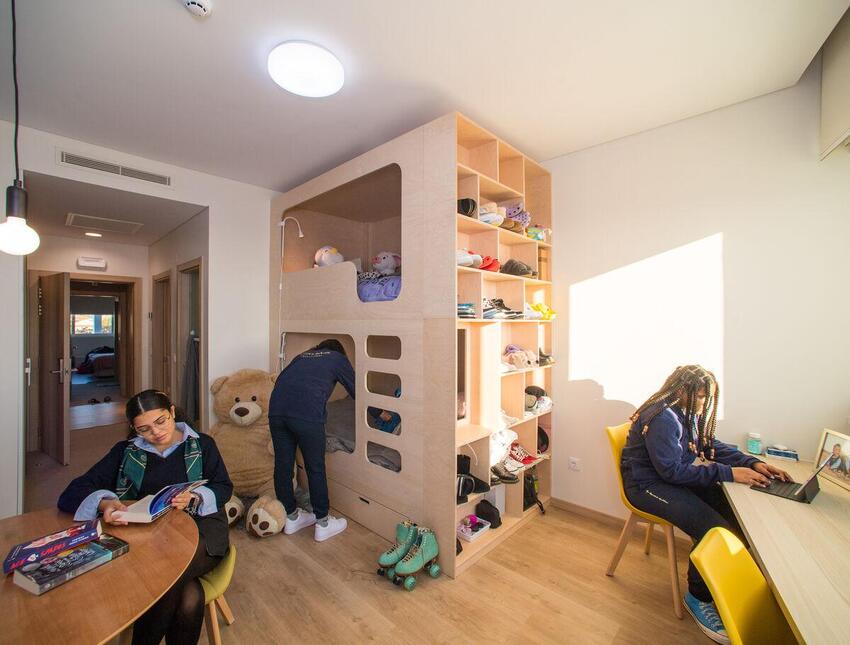
The school day at international schools typically starts between 8 AM and 9 AM and ends between 3 PM and 5 PM, with a structure similar to the British model. Classes are taught in English. Portuguese as an additional language is commonly offered to non-Portuguese-speaking students.
After school hours, extracurricular options include:
- Team sports (football, rugby, swimming) with access to the Atlantic
- Arts (drama, music, visual arts integrated into the IB or A-Levels program)
- Academic clubs (debate, robotics, STEM)
- Cultural activities in Lisbon and its surroundings on weekends
The boarding model keeps students on campus during the week. Weekends often feature organized activities and supervised visits to Lisbon, Sintra, and Setúbal.
For Portuguese-speaking students, language adaptation is immediate. For others, everyday Portuguese outside the classroom accelerates the acquisition of a second European language.
Why Portugal instead of the UK or the USA?
Portugal combines international credentials with a cost of living lower than the UK, Switzerland, and major European capitals.
Other objective advantages:
- Schengen Area: Students with a D4 visa in Portugal can travel through 26 European countries without an additional visa
- Language: for Portuguese-speaking students, cultural adaptation is immediate and culture shock is reduced
- British/IB credentials at European cost: A-Levels or IB Diplomas issued in Portugal carry the same weight as those obtained in the UK
- Geographical proximity: direct flights to most home countries make family visits easier
How does the D4 visa work for students under 18?
The D4 visa is the long-stay national visa for students coming to study in Portugal. For students under 18, the process is managed by AIMA (Agency for Integration, Migration, and Asylum).
Required documents include:
- Proof of enrollment or acceptance letter from the Portuguese school
- Travel and stay authorization signed by parents or legal guardians, duly legalized
- Photocopy of the legal guardians' identification document
- Proof of financial means for support during studies
- Health insurance valid in Portugal
For students under 16, according to AIMA, a Portuguese criminal record check or background certificate is not required. As of April 2026, the process now requires in-person attendance at VFS Global Application Centers.
How to validate high school completed in Portugal in the home country
Families who return home usually apply for academic equivalency with the local education authority. The general flow is:
- Sworn translation of the transcript and diploma, when the home country requires it
- Equivalency request at the education authority where the student will live
- Review and issuance of the equivalency declaration
Timelines vary by country. The practical step is to request the transcript and diploma from the school in Portugal before returning.
Frequently Asked Questions about High School in Portugal
Is high school in Portugal recognized for college admissions in the home country?
Yes. The Portuguese secondary education diploma is recognized in the home country through a study equivalency process at the State Secretariats of Education, which issue the Declaration of Equivalency required for access to higher education.
Do you need to know English to study at an international school in Portugal?
It depends on the format. Schools with a British or IB curriculum teach in English, so the language is a functional prerequisite. Bilingual schools accept students with an intermediate level. Portuguese public schools operate entirely in Portuguese.
What is the difference between boarding school and high school in Portugal?
Boarding includes accommodation and supervision on campus; at a day school, the student returns home daily. The boarding vs high school guide details the differences. International options in Portugal are predominantly boarding.
Is Portugal part of the Schengen Area? Does this affect the student visa?
Yes. With the Portuguese D4 visa, the student can travel through the 26 countries of the Schengen Area without an additional visa. The condition is to keep the visa active and maintain regular enrollment in Portugal.
How long before classes start should the family begin the visa process?
With the change in April 2026, which requires in-person attendance at VFS Global, the process can take 4 to 8 weeks. It is recommended to start the process at least 3 months in advance to ensure sufficient time in case additional documentation is requested.
Frequently asked questions about high school in Portugal
Is the Portuguese diploma recognized for university?
Yes, through the home country's equivalency process. Ask the school in Portugal for the transcript and diploma before returning.
Does an international school in Portugal require English?
It depends on the format. British or IB curricula are in English. Bilingual schools accept an intermediate level. Portuguese state schools teach in Portuguese.
What is the difference between boarding and day school in Portugal?
Boarding includes housing and campus supervision; in a day school the student goes home. The boarding vs high school guide covers the differences. International options in Portugal are mostly boarding.
Is Portugal in the Schengen Area, and does that affect the visa?
Yes. With a Portuguese D4 visa the student can travel through the 26 Schengen countries without an extra visa, while the visa and enrolment in Portugal stay active.
How early should the family start the visa?
The in-person VFS Global appointment needs lead time. Start at least three months ahead, in case extra documents are requested.
Be Easy: boutique study abroad consultancy
Choosing the national curriculum, IB or A-Levels in Portugal depends on age, language and university destination. A senior consultant matches that in the high school abroad program. Get in touch with us to build the project.

