
Germany Blue Card 2026 and permanent residence
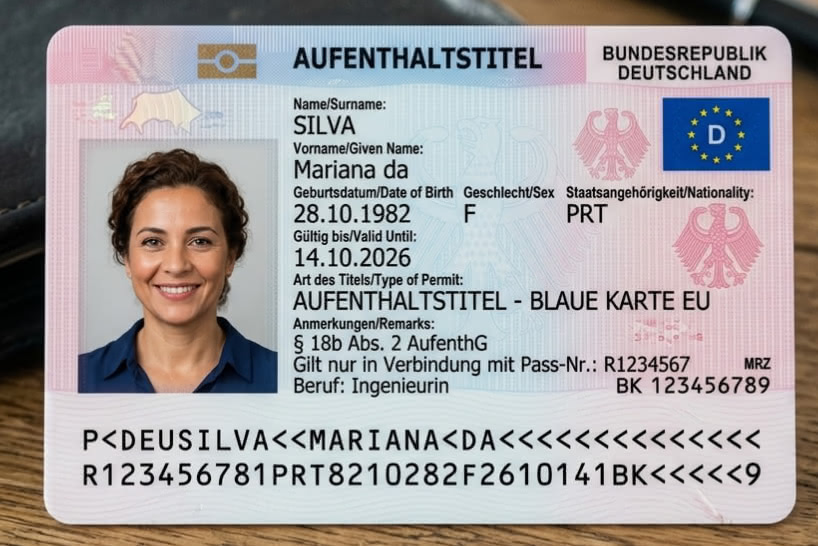
The Blue Card is the residence title for highly qualified professionals from outside the EU. It shortens the path to the Niederlassungserlaubnis (settlement permit, the German permanent residence). Since January 1, 2026, the standard salary threshold of the EU Blue Card in Germany is 50,700 euros gross per year.
What is the Blue Card in Germany in 2026?
The EU Blue Card (Blaue Karte EU) is a residence visa for qualified work, laid out in German law (paragraph 18g of the Residence Act, AufenthG). As a rule, the authority issues the card for up to four years, according to the BAMF (Bundesamt für Migration und Flüchtlinge).
Three conditions structure the basic eligibility:
- Contract or binding offer of at least six months
- Role compatible with the candidate's qualifications
- Higher education degree recognized or comparable to the German standard
Those who do not yet have an eligible salary offer usually build the foundation first. Many arrive through study and work in Germany, gain a local network and only then aim for the Blue Card.
What are the official salary thresholds in 2026?
The thresholds change every year, based on the contribution ceiling of the German pension system. Make it in Germany publishes the current values. In 2026, two annual gross floors apply:
- Standard: 50,700 euros per year for most occupations with a higher education degree and a compatible contract.
- Reduced: 45,934.20 euros for shortage occupations (Mangelberufe), for those who completed their last degree less than three years ago and, under specific rules, for IT specialists with proven experience.
- BA approval: at the reduced threshold, the Federal Employment Agency must approve the job in the visa process.
- Monthly floor (reference): about 4,225 euros gross at the standard threshold and about 3,828 euros at the reduced one, if the contract is monthly and stable.
In the salary map for Germany in 2026, the market range crosses the card's floor. Without a contract that reaches the threshold, the Blue Card simply does not open.
Who can apply for the Blue Card?
The classic profile is a professional from outside the EU with a recognized higher education degree and a qualified job offer in Germany. The role must make sense with the training.
Any contract in any field is not enough. There are important flexibilities:
- Recent graduates (less than three years since the last degree): can use the reduced threshold in any profession, with BA approval.
- Shortage occupations: engineering, health, IT and other Mangelberufe lists enter with a lower floor when the BA approves.
- IT with experience: in certain IT roles, the rule admits candidates without an academic degree if there are, in general, at least three years of relevant professional experience in the last seven years, a salary at the reduced threshold and BA approval.
Those aiming at high-demand sectors find a faster fit. The in-demand professions in Germany are the thermometer of where offers tend to track the card's threshold.
Why does the Blue Card shorten permanent residence?
The Niederlassungserlaubnis is the German permanent residence. With the Blue Card, the facilitated timeline is the main attraction compared to other work titles.
According to the BAMF:
- 27 months of highly qualified employment with pension contributions and basic German (around A1) are enough to request the settlement permit.
- 21 months with German at B1 level (adequate knowledge) shorten the timeline even further.
On common work visa paths, the wait for permanent residence is usually much longer. The Blue Card concentrates qualified employment, contributions and language in a regulatory shortcut.
The permanent residence in Berlin guide illustrates how the same destination changes pace depending on the residence title. Language stops being a cultural detail and becomes a calendar lever: those who invest early in German can cut six months from the path to the Niederlassungserlaubnis.
Blue Card, Opportunity Card and study and work: what is the difference?
Three routes appear together in conversations about Germany. They solve different problems.
- Blue Card: requires an offer (or contract) with a salary at the threshold and a compatible qualification. It is a work and residence title already in the eligible job.
- Opportunity Card (Chancenkarte): is a points-based search route, for those who do not yet have a contract at the Blue Card threshold. It serves to enter and look for a job on the ground.
- Study and work: combines education, part-time work permission during the course and, in many cases, a search window after graduation. It builds a European degree, network and language level before the eligible contract.
The Opportunity Card as an entry door makes sense when the profile is still being built. The study and work project in Germany is usually the step for those who need local qualification and a network before the blue card.
How does the academic stretch prepare the Blue Card?
Few arrive with a degree, German and an offer at the threshold on the same day. The most stable path we follow in our curation is sequential:
- enter with education or language study with work allowed
- build a network, a local resume and internships or part-time work
- use the search window after graduation
- sign the eligible contract and open the Blue Card
Areas with strong absorption speed up that curve. In engineering in Germany in 2026 and in IT in Germany in 2026, the market salary usually matches the threshold. See how pay shows up in daily life:
- Master's in IT with a view to permanent residence: an example of a trajectory where a European degree and an offer meet.
- The path from German to permanent residence: language is not just classes, it is a shortcut in the 21-month timeline.
Which documents and government fees enter the process?
The exact list depends on the consular mission and the local Ausländerbehörde. In general terms, the process asks for:
- Valid passport and forms from the competent authority
- Degree and, when required, proof of recognition or comparability
- Work contract or binding offer with annual gross salary
- Employment declaration completed by the employer
- Health insurance and proof of address according to the stage (entry visa or card in the country)
- Biometrics and, at the reduced threshold, processing with the BA
On citable official fees:
- EU Blue Card fee in the country: around 100 euros at initial issuance, according to the European Commission's immigration portal for Germany.
- National entry visa (type D): separate consular fee, confirmed at the German mission in the home country.
- Niederlassungserlaubnis: fee at the local authority, generally up to around 150 euros, according to Make it in Germany, with the exact amount at the Ausländerbehörde.
There is no universal checklist copied from a forum. The year's salary threshold and the degree recognition drive the process. Booking an appointment without these two points aligned only creates rework.
What does the Blue Card holder's family gain?
The Blue Card also organizes reunification. Spouse and children can come along under facilitated conditions compared to other titles. The spouse, as a rule, gets a work permit without the holder's salary threshold.
This changes the planning for those thinking of moving with a partner or children. The math now includes school, the spouse's work and the household's language calendar:
- Validate city and cost of living before the eligible contract
- Map school and the family's support network
- Use the study and work in Germany stretch as a real test of the destination
Which mistakes block the Blue Card in 2026?
The most common blocks are not impossible bureaucracy. They are profile misalignments.
- Salary below the current threshold: a contract close to the value is not enough. The annual gross must match the correct calendar year (2026: 50,700 or 45,934.20).
- Role disconnected from the degree: a generic position with no relation to the qualification raises questions.
- Degree without recognition or comparability: the home university's paper must be readable in the German system.
- Ignoring the BA at the reduced threshold: recent graduates, shortage occupations and IT under the special rule depend on that approval.
- Betting only on the card without a network: those who arrive without language, contacts or local experience take longer to find an offer at the floor.
The curation we see working starts with a realistic map: language, city, sector and entry format. The contract comes after. The Blue Card is the prize of an already employable profile, not a magic first step.
Frequently asked questions about Germany Blue Card 2026
What is the minimum salary for the Blue Card in Germany in 2026? The standard is 50,700 euros gross per year, according to Make it in Germany. The reduced threshold of 45,934.20 euros applies to shortage occupations, recent graduates (degree less than three years ago) and certain IT profiles, with Federal Employment Agency approval.
How long does the Blue Card take to lead to permanent residence? With qualified employment and pension contributions, the BAMF indicates 27 months with basic German and 21 months with B1 level. Without the card, other work titles usually require longer timelines to the Niederlassungserlaubnis.
Do I need to speak German to get the Blue Card? For the Blue Card issuance itself, the main focus is qualification, contract and salary at the threshold. German weighs heavily in the permanent residence shortcut: B1 shortens the timeline from 27 to 21 months.
Are the Blue Card and the Opportunity Card the same thing? No. The Blue Card requires an eligible job offer. The Opportunity Card is a points-based search title for those still looking for a contract. They are different stages of the same international career path in Germany.
Does studying in Germany help reach the Blue Card? Yes, when the project generates a recognized degree, a local network, language and access to vacancies with a salary at the threshold. The post-graduation search window and well-chosen internships are usually the bridge between the course and the eligible contract.
You already understand the Blue Card. What about your path in Germany?
If the profile still needs language, a European degree or a network in the German market, the next step is to set up the right sequence: education or structured search before the offer at the threshold. The study and work curation in Germany organizes that bridge with clarity of sector, city and calendar.
Be Easy: boutique exchange consultancy
Be Easy supports those who want to build an international career in Germany with visa and market realism. If the Blue Card is the regulatory destination, we set up the curation of study and work, language and professional positioning with a dedicated senior consultant at every step. Get in touch with us to receive specialized senior consulting.

